Thursday, June 29, 2006
Thoughts on Swimmers Pic
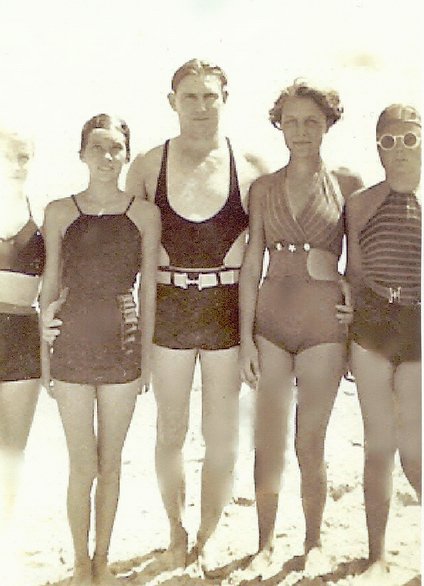
I was amazed when I first saw this picture (see previous post). This shot was taken sometime in what I believe to be the nineteen thirties. I believe, we found it in among some old heirlooms that had been stored away (I’ve had it a while, so I can’t be certain). My first impression was the animation of the people. They’re not staring blankly into the camera like so many old timey pictures do. Must be having too much fun swimming. Check out the swim suit designs. The two-piece (left most) was a complete surprise - ahead of its time? And the one-side moon shaped cut out on the woman’s suit is pretty radical. Also those white swim goggles. They are so cool!


Tuesday, June 27, 2006

Friday, June 16, 2006
Swim Suit Analytics
OK, this AM I wore the skimpy speed suit. I wanted to get a comparison to yesterday's horrible performance when I wore the drag suit. Today I dropped my time for the same distance by 104 seconds or 5.78 percent just by using a suit that slips through the water easier. Now I know why those swimmers shave their heads before a race! Sorry, I'm not planning an analysis of those low belly cut suits in this blog :0
Thursday, June 15, 2006
Swim Suit Choice Revisited
I want to revisit a topic which I am finding more important than I ever could have imagined - swim suit choice. It really is one of the most important factors you can make for any swimmer, beginner to expert. I’ll start with my main premise. You want a suit that is hydrodynamic (like an airplane is aerodynamic), meaning it flows through the water with little encumbrance. If you must fight through the water to get anywhere, you are going to where yourself out - unless that’s your goal (for fitness purposes). My aha moment came this morning during my workout. Generally I can complete the first part of my workout in less than 30 minutes. Today, it took a full minute more to go the same distance. Now that doesn’t sound like a lot, but let me add - I was pulling harder than ever (my lane was parallel to the swim team lane and I was “trying” to keep up - they were future Olympians I imagine. Ha ha). To add to that, my foot which I hurt about a week ago was finally healed, so I could kick well for the first time since the injury. If anything, I should have shaved time off this part of my workout. So what’s with the extra time? A loose fitting, hip length drag suit was the culprit. I didn’t buy it for its intended purpose - I was just trying to find something that didn’t make me look like a model for some skin magazine. It held the water and prevented me from getting any results from my efforts to glide. Perhaps the drag suit helps me build strength, but it did nothing for my pride. My suggestions? If you want speed and distance, go for the streamlined thigh huggers or the tight briefs (if your ego can stand it). Dump them in the waste basket as soon as they start poofing out from age and get a new pair. You’ll get better swimming results, I promise.
Wednesday, June 14, 2006

Pointing Elbows
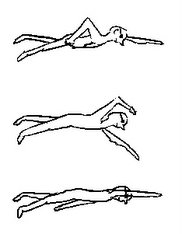
I must apologize for my artwork (see previous post). Also, please note this post is about freestyle arm movement - not kicking. I realize the pictures have the legs in the same position throughout. OK, I’m accused of not kicking much, so I suppose it’s accurate. Anyhoo, the drawing isn’t of me either - yet it sort of looks like it might be. Too weird.
Well, I wanted to talk about pointing your elbows. If you look at the top drawing and then at the picture (closely, maybe with a magnifying glass), you’ll see two demonstrations of pointing your elbow at the sky as you come out of your pull and go into your stretch. Try to scratch the sky with your elbow, i.e. make your arm come out of the water in a vertical position (or rather perpendicular to the water’s surface) - sort of like a shark fin.
Well, I wanted to talk about pointing your elbows. If you look at the top drawing and then at the picture (closely, maybe with a magnifying glass), you’ll see two demonstrations of pointing your elbow at the sky as you come out of your pull and go into your stretch. Try to scratch the sky with your elbow, i.e. make your arm come out of the water in a vertical position (or rather perpendicular to the water’s surface) - sort of like a shark fin.
Saturday, June 10, 2006

Arm Entry
How you put your arms in the water when you do the freestyle can be a big deal. Do it wrong and you impede your progress. Do it right and you can actually make yourself go faster. Watch different people do freestyle. Watch how some will put their arms in the water with their elbows sticking out to the side and their hands coming across the front of their heads. These people are in effect putting up a barrier in front of them each time each arm enters the water. Of course, this slows down waterever benefit they may have gotten from their previous pull and from their kick. Look for the people who are doing the stroke correctly. They put their hands in the water straight in front of them. Doing so creates no resistance to water flow and they get into position to pull the water just as fast. They even set themselves up for a longer pull - and a longer pull means you go futher with each stroke. Try it!
Wednesday, May 31, 2006
Be Happy - Swim
I've noticed when I'm getting to the pool in the morning - about 6:30am - there is a bunch of people leaving who are happier than any other group I meet all day. It's the Masters swim group. They get there at the crack of dawn. Why are they happy? I've had my theories - including it's because their work-out is over. But even the stray person I see when I'm done with my workout - we late risers don't finish as a group - are also pretty content. I came across this article today which talks about the psychological benefits of exercise. Nice read. Enjoy.
Thursday, May 25, 2006
Wasted Motion Means Wasted Energy
When I watch a novice adult swimmer, I am often amazed at all the effort that is being used -with no positive effect. Often the splash is huge, the waves large and the forward momentum near zero. What's wrong? Well I've already mentioned the torpedo profile at least a dozen times in this blog. Maintaining that profile is half the battle. It allows you to cut through the water and let it slide past with ease. So what's up with the thrashing arms and legs you see so many people using? It's total waste of motion and energy. The motion is not being applied appropriately. Swimming in a nutshell is a case of levers and fulcrums along with thrusts, pulls and pushes - each applied properly. The problem isn't just with novice swimmers. Even good swimmers could use a little "skinny swimming" - this is a term I picked up from a woman who was happy to share a lane with me one day when all the other lanes were full. She said she would practice her "skinny swimming." In essense, skinny swimming is deliberate swimming whereby you keep your arms straight ahead and along side your body while your legs stretch out behind. You do this, maintaining a profile as close to an arrow as possible. No wasted motion. Don't swing your arms out (like an eagle), or even straight up (like a windmill). What's the point? You aren't pulling anything but air if your arms are far out of the water. It may look cool, but you are only fooling yourself. Arms that stretch out of the water more than an inch or two are just using energy to fight gravity - that's all. Use that effort and apply it once you've reached the topmost point of your stretch, then apply it to a stronger, longer pull through the water.
Friday, May 19, 2006
Proper Breathing - Crank It Up
Keeping with the theme of streamlining your body position during freestyle stroke, it is imperitive that you don't destroy all your hard work when you go to breathe. Too many people - even people who believe themselves to swim well - lift themselves up to breathe, impeding the flow of water past their bodies. Their chests form a wall - creating virtual dams - against the water trying to flow past. Breathing when done properly is part of the stroke - not a separate step. It involves turning the body to the side. Vertically profiled fish are this shape naturally. You must do it deliberately. I have developed a routine which works for me. I'll share it with you here. Imagine two lever-armed cranks that go round and round on a single axel. Your arms are the two cranks - the axel is your collar bone. As you turn the crank, you can turn your body to the side on which you wish to breathe. I usually start turning my body to the side when my arm is near my hip. As I begin the recovery - bringing it forward, I slowly "crank" body to the fish-profile mode. It is here that I am in a natural - not forced - position to grab a mouthful of air. As my arm progresses past the top of the motion, I crank my head and body back to the normal flat - horizontal - position. Notice, I the breathing motion is part of the stroke. I'm finding that doing anything else is self-defeating and very tiring - no wonder people who swim poorly get worn out swimming just half-way across the pool!
Thursday, May 18, 2006
Another Way to Visualize a Straight Pull
I promised in my last post that I'd provide another helpful analogy for the freestyle pull. In past posts I talked about keeping a straight line - for streamlining purposes. Swimming pools have lanes painted along the bottom of each lane. When I'm doing my laps, I follow that line and often imagine it is a vertical ladder, along which I am suspended, parallel. To get from one end of the pool to the other, I imagine I must reach out and grab a rung of the ladder. To propel myself up the ladder, I imagine I must fight gravity, so I must pull the rung as hard as possible. When I get to my waist, I then must push the rung away, back behind me. When I've reach the maximum stretch behind me, I reach out and grab another rung with my other hand and repeat. This works to keep me straight and forces me to apply equal effort to both sides of my body. Perhaps you have an analogy that works for you - ideas are welcome!
Tuesday, May 16, 2006
Freestyle - My Secret to the Pull
I've drawn several analogies in my tips. Today and next time I'm going to include two more to give you an idea of how I approach the free-style pull. On dry-ground with your left hand touching your hip, stand on your tip toes and reach with your right hand as high as you possibly can. Imagine you are reaching for an apple hanging from a high tree branch. You can reach the bottom of the apple, but just barely. The way you get to your hand around the apple is to thrust your body up expanding your reach by the length of your lunge. The is where you start your freestyle pull. You've snagged the apple. You pull in down. Bring it to your waist and at that point, throw it back as far as you possibly can. Now repeat this with the other hand. Sounds silly right? Well, that's literally what you must do in the water. You must lunge as far forward as you possibly can, maintaing the torpedo profile. Cup your hand to hold as much water as possible. Maintaining that water in your hand pull it through to your waist (open your hand and you drop the apple - i.e. lose the water - where you throw it away behind you as hard as you possibly can. Your hand should end up touching your hip. Try it. You should get two distinct propulsion results out of this arc. First is the pull between picking the apple and your waist. Second is the push, where you throw the apple away. If you already know how to swim, you may find you can increase your speed proportionally to how much you increase the force of either (the pull and push) parts of the arc. Next post I'll tell you about the next analogy - climbing the ladder.
Wednesday, May 10, 2006
Picking a Pair of Swim Goggles
Off topic, but relevant, today we discuss goggles. Read bottom of post for my choice - you won't believe it it's so cool! First off, don't worry about what they look like. All goggles make the most attractive person look like an alien. Go for utility and lifespan. Obviously, you want them to fit snuggly so they don't leak. Avoid anything cheap - almost by definition, they'll leak. I prefer the single piece molded variety and avoid the three piece units (those with the snap on nose piece). Larger varieties are catching on - Navy Seals use these. But take note, Olympic swimmers seem to prefer the smallest types. I also look for a strap that I can adjust easily. Some are nearly impossible to adjust, while others have a poor rubber quality that breaks soon after purchase. Choose a name brand you are familiar with. You pay a little more, but you usually are ensured some level of quality. OK, here's an awesome pair of goggles. I want a pair - NOW! Attention vendors - I'll volunteer to be the first customer and guarantee you a mention in this blog.
Tuesday, May 09, 2006
Exaggerated Follow Through
Exaggerated Follow-Through. If you are an experienced swimmer or tried yesterday’s suggestion about brushing your ear as you pull your arm back in your follow-through you know I was exaggerating when I told you to tap your ear with your finger. Tried it this AM myself - doesn’t work. Here’s what does … As you pull up, you really do want to try to keep your arm and hand as close to your body as possible. Instead of your ear, try tapping just under your arm pit as you pull your arm up from your hip. After you reach your arm pit, shoot your hand forward. End with your fingers pointing forward and your arm parallel to the side of your head - touching your head if possible. Remember the main goal - you want to force yourself to maintain a consistent torpedo shape for slip-streaming purposes.
A Clarification about Follow-Through
If you are an experienced swimmer or tried my suggestion about brushing your ear as you pull your arm back in your follow-through you know I was exaggerating when I told you to tap your ear with your finger tips to your ear as you follow-through. I do exaggerate from time to time to make my point - please excuse me. You really do want to try to keep your arm and hand close to your body as possible as you pull up. Try tapping just under your arm pit as you pull your arm up. End with your fingers pointing forward and your arm parallel to the side of your head. Touching if possible. Remember the goal is a consistent torpedo shape for slip-streaming purposes.
About Prior Described Follow-Through
Follow Through Post was Exaggerated - If you are an experienced swimmer or tried my suggestion about brushing your ear as you pull your arm back in your follow-through you know I was exaggerating when I told you to tap your ear with your finger tips to your ear as you follow-through. I do exaggerate from time to time to make my point - please excuse me. You really do want to try to keep your arm and hand close to your body as possible as you pull up. Try tapping just under your arm pit as you pull your arm up. End with your fingers pointing forward and your arm parallel to the side of your head. Touching if possible. Remember the goal is a consistent torpedo shape for slip-streaming purposes.
Monday, May 08, 2006
Rubbing Ears Proper Freestyle Follow Through
Rubbing Ears - Proper Freestyle Follow Through
OK, so we’ve covered the minimum on freestyle pull. Now you want to get your arm back to the point of the torpedo. Again, we want to keep the streamline shape so we can keep the body flowing through the water. To do that, your recovery must be streamlined too. Lot’s of people screw this part up. They just swing their arms out, slowing themselves down and sometimes even whacking the poor people sharing the same lane. Both are pitiful. Here’s what’s wrong. Like the pull, you want your arms to come along side your body. Only you must bend your elbow. Do this - again, in front of your mirror. With left hand extended and right hand by your hip, draw your right hand up to your ear -then straight up and adjacent to the hand pointing up. Try to keep your elbows as close to your body as possible. Yes, it’s awkward. Now try it reversing the hand positions. When I taught my daughter this technique, I told her to bump her ears with each stroke. She became the fastest swimmer on the team from the get-go.
OK, so we’ve covered the minimum on freestyle pull. Now you want to get your arm back to the point of the torpedo. Again, we want to keep the streamline shape so we can keep the body flowing through the water. To do that, your recovery must be streamlined too. Lot’s of people screw this part up. They just swing their arms out, slowing themselves down and sometimes even whacking the poor people sharing the same lane. Both are pitiful. Here’s what’s wrong. Like the pull, you want your arms to come along side your body. Only you must bend your elbow. Do this - again, in front of your mirror. With left hand extended and right hand by your hip, draw your right hand up to your ear -then straight up and adjacent to the hand pointing up. Try to keep your elbows as close to your body as possible. Yes, it’s awkward. Now try it reversing the hand positions. When I taught my daughter this technique, I told her to bump her ears with each stroke. She became the fastest swimmer on the team from the get-go.
Skip the Dog
Confident kids generally learn dog paddle before they learn free-style. We're going to skip all that and go right into stroke technique. We're back home in front of the mirror for this lesson. Face the mirror with about three feet between you and any incumbrances - e.g., a sink, perhaps. Now raise your hands and put them above your head in the torpedo pose - straight arms, locked elbows, thumbnails together, fingers flush together and gently palms cupped (as if holding water). Keeping it straight, swing your right arm down, parallel to your body, until it touches your leg. Keep the other arm up - don't move it. You've done half a proper stroke and if you were in a pool you would now be gliding. Now try this with the left arm, keeping your right arm extended over your head (don't worry about swinging it back yet - that's a whole topic to itself). Now let's look at what you've done. You've swung your arms parallel to your body and kept your non-stroking arms straight over your head. Why? You want to maintain the torpedo profile for the water to slipstream past you. Next, you've kept your pulling arms straight. Why? You want to maximize the pulling lever. A long arm, provides a more powerful stroke than a bent arm. As easy as it is here in front of the mirror, this is tricky in the water and where nearly everyone does it wrong in the pool. Practice this motion and repeat it until you understand what is described above fully. Recovery next time.
Subscribe to:
Posts (Atom)